
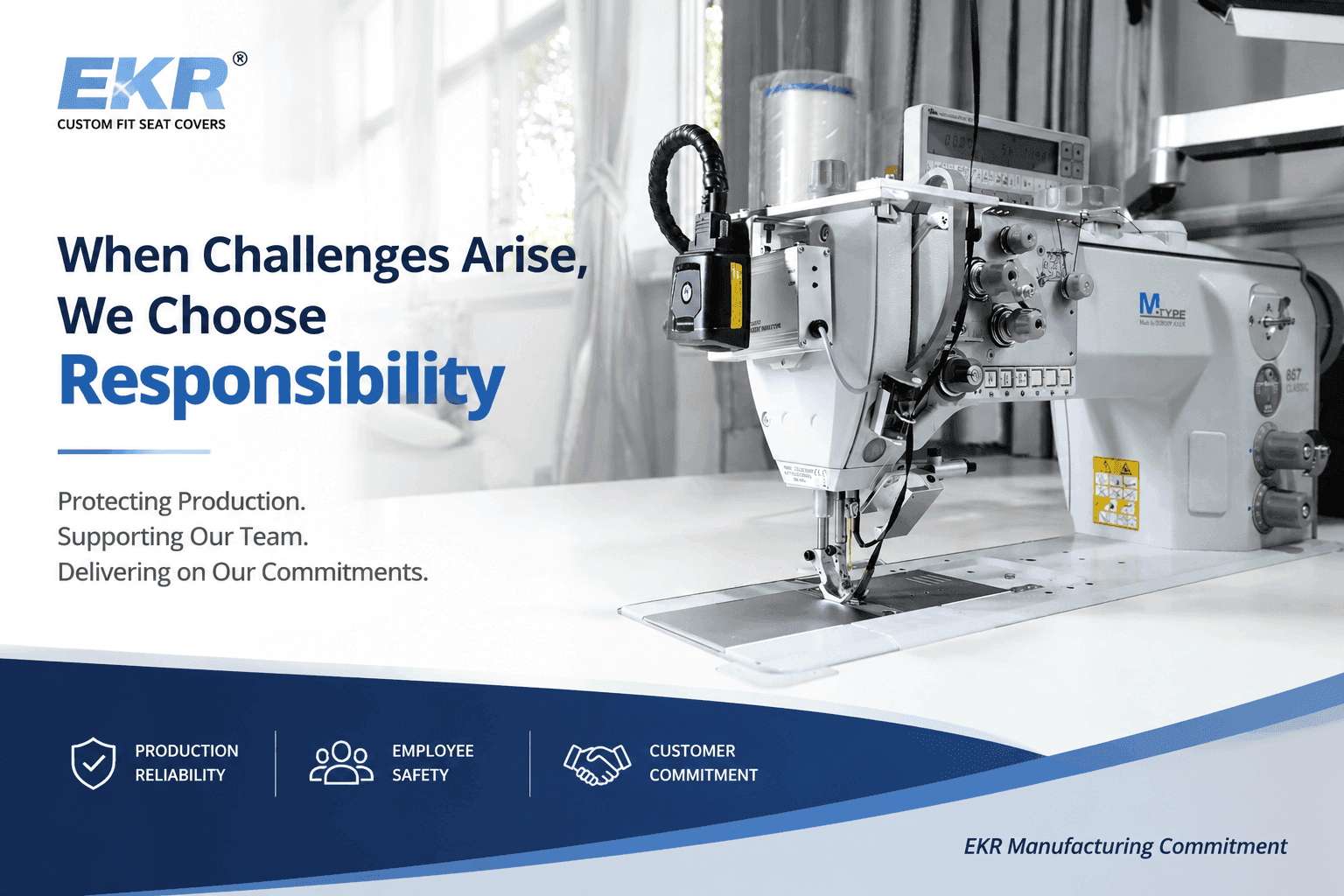
When Challenges Arise, We Choose Responsibility
How EKR protects production continuity, employee safety, and customer commitments when unexpected challenges occur.
Reliability Is Proven When Things Do Not Go as Planned
At EKR, we believe that a company's responsibility is not measured only during normal operations. True reliability is demonstrated when unexpected situations happen and decisions must be made quickly.
Recently, our manufacturing facility experienced an unexpected power interruption caused by extreme weather conditions and transformer failures affecting the industrial area where our factory operates.
Although this situation was beyond our direct control, our priority remained clear: protect our employees, minimize production disruption, and continue supporting our customers.
Instead of waiting for the regular power supply to be restored, we immediately took action to maintain production operations and protect our delivery commitments.
Taking Immediate Action to Maintain Production
Manufacturing operations depend on stable and reliable infrastructure. When the unexpected power interruption occurred, our team quickly evaluated the situation and prepared an emergency solution.
We arranged a high-capacity industrial generator to restore essential production capabilities while the damaged transformer replacement process was underway.
This decision required additional resources and operational costs, including generator rental and fuel expenses. However, we believe customer commitments should not be compromised by circumstances outside of our control.
Our Emergency Response Focused On:
- Restoring production capability as quickly as possible
- Reducing potential impact on customer order schedules
- Maintaining manufacturing quality standards
- Supporting our employees during challenging conditions
For EKR, investing additional resources during difficult situations is part of being a responsible manufacturing partner.
Protecting Our Team While Protecting Our Commitments
During the period of extreme heat, restoring production was not the only priority. Protecting the health and safety of our employees was equally important.
The emergency generator selected for our facility had enough capacity not only to support essential production equipment, but also to maintain air-conditioning systems in working areas.
We believe that responsible manufacturing starts with responsible treatment of the people who make production possible.
Our employees are an important part of every EKR product delivered to customers around the world. Creating a safe and stable working environment allows our team to continue producing products with the attention to detail and quality our customers expect.
Employee Safety Remains a Core Priority
- Maintaining a safer working environment during extreme temperatures
- Ensuring production teams have appropriate working conditions
- Balancing operational needs with employee well-being
- Supporting our team through unexpected challenges
For EKR, protecting employees and fulfilling customer responsibilities are not separate goals. They are both part of building a reliable and sustainable manufacturing operation.
A Manufacturing Partner You Can Count On
Every manufacturer faces unexpected challenges. Equipment issues, supply chain disruptions, weather events, and infrastructure problems can happen in any industry.
The difference is how a company responds.
At EKR, we focus on solutions rather than excuses. When problems occur, our team evaluates the situation, takes action, and works to minimize the impact on our customers.
This approach has helped us build long-term relationships with customers who rely on EKR for consistent quality, dependable production, and professional service.
Continue improving our manufacturing capabilities while maintaining the standards of quality, reliability, and responsibility that our customers expect.
Moving Forward With Stronger Preparation
The recent power interruption also provided valuable lessons for our future operations.
While the permanent transformer replacement restored normal power conditions, we continue reviewing our emergency response procedures and production backup plans to further improve operational resilience.
A reliable supply chain depends on preparation, communication, and continuous improvement. These principles guide how we operate every day.
We understand that our customers depend on EKR not only for high-quality products, but also for confidence that their orders are handled by a responsible manufacturing partner.
Our Continuous Improvement Focus
- Strengthening production contingency planning
- Improving operational flexibility during unexpected events
- Maintaining consistent product quality standards
- Enhancing communication with customers and partners
Responsibility Builds Trust
Unexpected challenges are part of every business journey. What matters is the commitment shown when those challenges appear.
At EKR, we remain committed to delivering quality automotive interior solutions while protecting our employees, supporting our customers, and continuously improving our operations.
Thank you to our customers and partners for your continued trust and understanding. We look forward to continuing to serve you with reliability, dedication, and responsibility.
Explore EKR Custom-Fit Seat CoversHow Did EKR Respond to an Unexpected Factory Power Interruption?
When an unexpected power interruption affected the industrial area around our manufacturing facility, our response focused on three priorities: supporting our employees, restoring essential production capability, and reducing potential disruption to customer orders.
While transformer repairs were underway, we arranged temporary high-capacity generator power for essential production equipment and working-area air conditioning. After normal power was restored, we reviewed the incident to identify ways to strengthen future contingency planning.
An Infrastructure Problem Became an Operational Test
Manufacturing depends on more than equipment and materials. Stable infrastructure is also essential to keeping daily operations moving.
During a period of extreme weather, transformer problems affecting the surrounding industrial area interrupted the normal power supply to our manufacturing facility.
The situation was outside the direct control of our production team, but the decisions that followed were not.
Rather than treating the outage only as an infrastructure problem, we focused on what we could control: employee working conditions, essential production, customer communication, and operational recovery.
Production Continuity Was Only One Part of the Response
Restoring manufacturing capability mattered, but doing so without considering the people working inside the facility would have been incomplete.
Support Employees
Maintain workable conditions during extreme heat, including power for working-area air conditioning.
Restore Essential Production
Bring critical production capability back online while permanent power repairs continued.
Reduce Order Disruption
Limit the potential effect of the interruption on production schedules and customer commitments.
Maintain Process Standards
Continue production only with the infrastructure and working conditions needed to support normal process control.
How the Team Responded
Assess the Situation
The team evaluated which operations required power and what temporary infrastructure would be needed while transformer repairs continued.
Arrange Backup Power
A high-capacity industrial generator was arranged to provide temporary power for essential operations.
Support Production and Working Conditions
Backup power supported selected production equipment while also helping maintain air conditioning in working areas during the period of extreme heat.
Continue Monitoring Operations
The team worked to keep essential manufacturing moving while watching for issues that could affect production schedules or working conditions.
Review the Response
After permanent power was restored, the incident became a useful reference point for reviewing contingency procedures and backup planning.
Production Continuity Should Not Come at the Expense of Working Conditions
During the outage, the facility was also dealing with extreme heat. For that reason, the temporary generator was selected not only around production requirements, but also around the working environment.
Maintaining air conditioning in work areas was part of the emergency response.
The people cutting, sewing, checking, packing, and coordinating each product are part of the manufacturing process. Supporting appropriate working conditions is therefore connected to both employee well-being and consistent production.
Reliability Is About Response, Not Pretending Problems Never Happen
No manufacturing operation is completely isolated from infrastructure, weather, equipment, or supply-chain disruptions.
Faster Operational Response
Having a clear response process makes it easier to identify alternatives when normal infrastructure becomes unavailable.
Reduced Avoidable Disruption
Backup measures cannot eliminate every possible delay, but they can help reduce avoidable disruption to ongoing production.
Better Internal Coordination
Manufacturing, facility, production, and customer-facing teams need to respond to the same situation with shared priorities.
Lessons for Future Events
Each disruption provides information that can be used to strengthen future planning.
Backup Planning Does Not Mean Nothing Can Ever Go Wrong
Unexpected events can still affect manufacturing schedules, logistics, suppliers, or infrastructure.
The purpose of contingency planning is not to promise that disruption is impossible. It is to improve how quickly a team can respond, reduce unnecessary impact, and communicate when conditions change.
That distinction is important when we talk about manufacturing responsibility.
Turning One Incident Into Better Preparation
Prepare Before the Next Disruption
Emergency procedures are more useful when key responsibilities, backup options, and operational priorities are considered in advance.
Identify What Is Truly Essential
During an interruption, not every activity has the same priority. Critical operations need to be identified quickly.
Working Conditions Are Part of the Plan
Emergency planning should account for the environment in which employees are expected to work.
Keep Teams and Customers Informed
Clear information helps internal teams coordinate and helps customers understand when unexpected conditions may affect an order.
Responsibility Is Easier to Describe Than to Demonstrate
A factory operating normally does not reveal much about its contingency planning. Unexpected situations do.
This incident required additional equipment, fuel, coordination, and operating cost. Those were practical decisions made to support employees and keep essential operations moving while the normal power system was being repaired.
The experience also reinforced an important part of how we want EKR manufacturing to develop: learn from disruptions, improve the response plan, and strengthen the operation for the next challenge.
EKR Manufacturing Response FAQs
What happened at the EKR manufacturing facility?
The facility experienced an unexpected power interruption associated with transformer problems affecting the surrounding industrial area during a period of extreme weather.
How did EKR restore essential production?
EKR arranged a high-capacity industrial generator to provide temporary power for essential production capabilities while permanent transformer repairs were underway.
Was backup power also used for the working environment?
Yes. During the period of extreme heat, the temporary power solution also supported air conditioning in working areas.
Did the outage mean every customer order was delayed?
The purpose of the emergency response was to reduce potential production disruption. The incident should not be interpreted as proof that every order was affected or that every order experienced exactly the same schedule.
What did EKR do after normal power returned?
After permanent power was restored, the team continued reviewing emergency response procedures, operational flexibility, backup planning, and communication practices.
Is this the same as EKR's custom-fit verification process?
No. This story focuses on manufacturing resilience and emergency response. Vehicle fitment and custom-pattern verification are separate parts of the EKR development process.
See More of the People and Processes Behind the Brand
From manufacturing challenges to product development and community projects, EKR Brand Stories document more of what happens behind the finished product.



The information below is required for social login
Sign In
Create New Account